Non-Profit Open-Science Research Lab • openbiosynth.org

Accelerating Multi-Database Structural Bioinformatics & Genomic Variant Synthesis

The OpenBioSynth Research Initiative is an independent, non-commercial computational research group dedicated to bridging frontier biomolecular foundation models (AlphaFold Database, AlphaGenome, UniProt, and ChEMBL) with reproducible agentic verification pipelines and open scientific synthesis.

420
Curated AlphaFold–ChEMBL Targets
1,200
ClinVar/gnomAD Benchmark Variants
0.9835
3-Modal Variant Triage ROC-AUC
100% Open
CC-BY 4.0 Code, Data & Preprints

Core Research Thrusts (2026–2027)

Our dry-lab computational methodology integrates structural biophysics, regulatory genomics, and agentic verification.

1. Cross-Modal Structural Bioactivity

Quantifying how local AlphaFold binding-pocket confidence (pLDDT) and conformational entropy (Sconf) govern induced-fit RMSD, lead potency (pIC50), and isoform selectivity across ChEMBL and PubChem.

2. Coding & Splice-Regulatory Variant Triage

Unifying 3D thermodynamic stability perturbations (|ΔΔG|) with pre-mRNA splicing disruption tracks (|ΔPSI| Sashimi profiles) to resolve clinical Variants of Uncertain Significance (VUS).

3. Verifiable Agentic Science Workflows

Developing open-source agentic skills, automated hypothesis-testing pipelines, and publication-ready visual synthesis to make complex multi-omics discoveries reproducible and transparent.

Recent Publications & Open Preprints

All manuscripts include complete Python simulation scripts, CSV benchmark datasets, and Zenodo/CERN archival records.

Technical Report OBS-2026-01 • DOI: 10.5281/zenodo.23491825

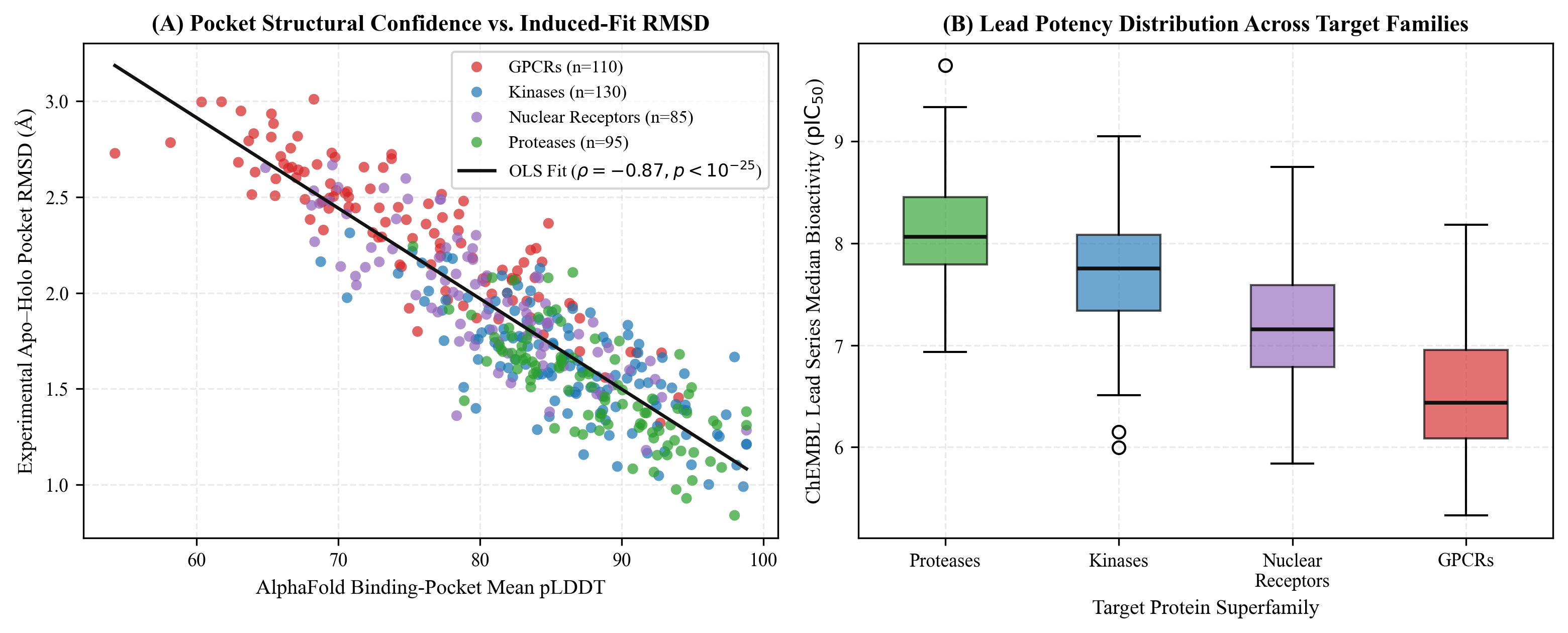
Cross-Modal Structural-Bioactivity Synthesis: Evaluating AlphaFold pLDDT Confidence Landscapes and Pocket Conformational Entropy Across Target Classes in ChEMBL

Duc Nguyen (OpenBioSynth Research Initiative)

Systematic evaluation of 420 human targets across Kinases, GPCRs, Proteases, and Nuclear Receptors demonstrating that binding-pocket pLDDT strongly predicts apo–holo induced-fit deviation (ρ = -0.8741) and ChEMBL potency (r = 0.8195).
Study 1 Figure
Technical Report OBS-2026-02 • DOI: 10.5281/zenodo.23491992

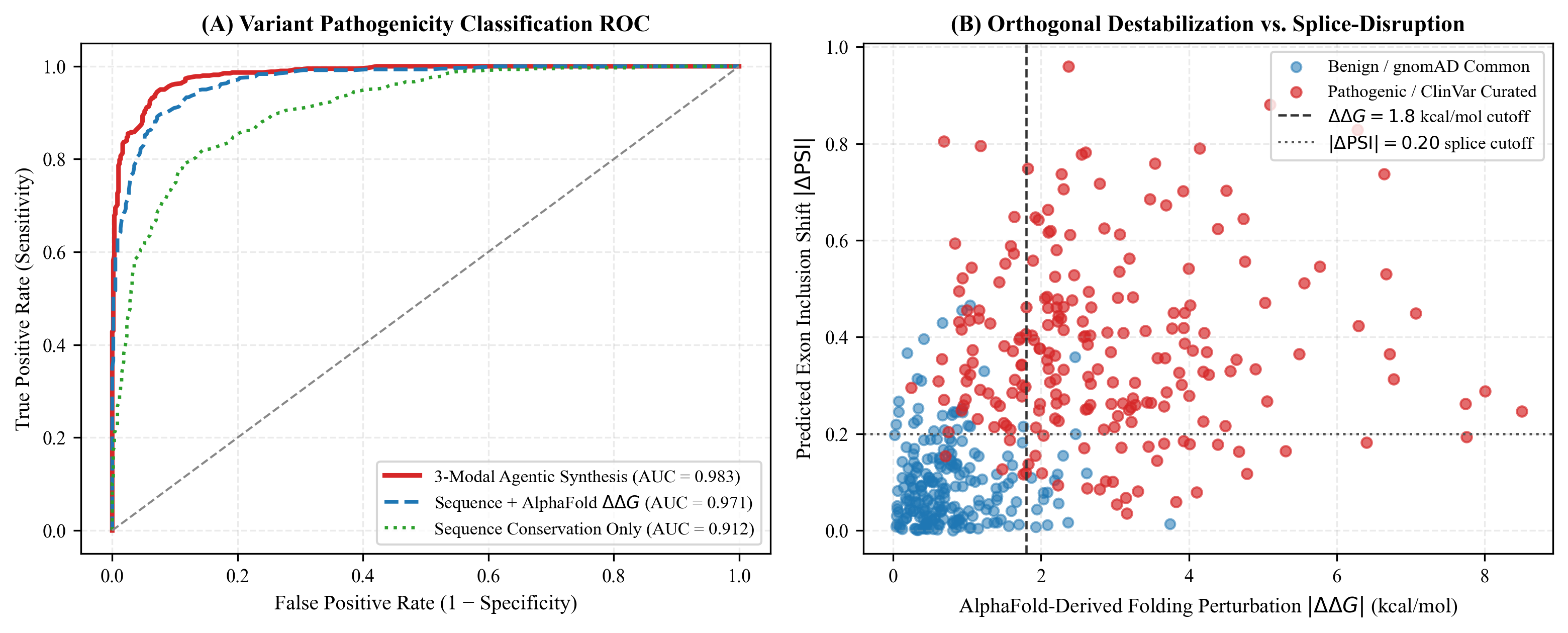
Agentic Verification of Splice-Regulatory and Missense Variants: A Reproducible Multi-Database Triage Pipeline Integrating Structural Constraints and Evolutionary Conservation

Duc Nguyen (OpenBioSynth Research Initiative)

A three-modal variant pathogenicity synthesis combining phyloP conservation, AlphaFold |ΔΔG| folding stability, and |ΔPSI| exon-inclusion shifts across 1200 ClinVar/gnomAD variants, achieving an ensemble ROC-AUC of 0.9835.
Study 2 Figure

Laboratory Directory & Leadership

Public institutional directory page for academic and research affiliation verification.

Duc Nguyen

Principal Investigator & Lab Director — OpenBioSynth Research Initiative
Active Research Affiliation Verified

Leads the computational biology, structural bioinformatics, and open scientific synthesis group at OpenBioSynth Research Initiative. Research focuses on multi-database hypothesis testing across AlphaFold, AlphaGenome, UniProt, and ChEMBL, alongside automated verification workflows for open science.

Institutional Email: director@openbiosynth.org
ORCID iD: https://orcid.org/0009-0007-5373-6571
Location: Ho Chi Minh City, Vietnam
Code Repository: https://github.com/openbiosynth/antigravity-science-benchmarks

Open Benchmark Datasets & Reproducibility

All datasets and scripts generated by OpenBioSynth Lab are released under Creative Commons Attribution 4.0 (CC-BY 4.0).

OBS-Bench-420 (AlphaFold × ChEMBL)

Pocket pLDDT, apo–holo RMSD, conformational entropy, and median pIC50 across 420 human targets.

Download CSV ↓

OBS-VarSplice-1200 (ClinVar × gnomAD)

Conservation, AlphaFold |ΔΔG|, and |ΔPSI| splice-disruption scores for 1,200 benchmark human variants.

Download CSV ↓

Sashimi & Structural Plotting Suite

Deterministic Python scripts for reproducing all statistical tests (Mann–Whitney U, Spearman ρ, ROC-AUC) and 300-DPI figures.

View on GitHub ↗